Mexican dual citizenship for your children
If you are Mexican, your children born in the United States can be Mexican too. We help you prepare to register their birth at the consulate so they can get a Mexican birth certificate, a CURP and a passport.
Being Mexican and American at the same time
Mexico’s Constitution says that people born abroad to a Mexican mother or father are Mexican by birth. That means if you are Mexican and your child was born in the United States, your child already has the right to Mexican nationality. What’s missing is making it official: registering the birth with the Mexican civil registry, usually at a Mexican consulate. With that registration your child receives a Mexican birth certificate, and with it can get a CURP and a Mexican passport.
The United States allows dual nationality: registering your child as Mexican does not take away U.S. citizenship. Your child stays just as American as before, and also has the same rights as any Mexican citizen in Mexico.
Who can get it?
- Sons and daughters born outside Mexico to a Mexican father or mother, whether they are minors or adults. Only one parent needs to be Mexican.
- Grandchildren of Mexicans. Since the May 2021 reform, a person born abroad is also Mexican by birth when their Mexican father or mother was likewise born outside Mexico. See how it works for grandchildren.
- Children of parents who became U.S. citizens. A Mexican parent who naturalized as a U.S. citizen can still pass on Mexican nationality. People who naturalized after March 20, 1998 kept their Mexican nationality automatically; if it was before that date, we explain the extra step you may need.
- Adults who were never registered. An adult can register on their own, with a few extra documents.
How we help
The consulate appointment is short, and if a single paper is missing you have to start over. Our job is to keep that from happening:
- We review your documents before the appointment, one by one, against the requirements of your consulate.
- We catch the problems that most often delay a registration: names that don’t match between the U.S. birth certificate and the Mexican birth certificates or IDs, missing marriage certificates, the father’s consent when the parents weren’t married, or what to do if a parent has passed away.
- We help you request the appointment through the consulate’s official channels and fill out the application.
- We explain the next steps: how to get your child’s CURP and Mexican passport once the birth certificate is issued.
Who does what
The birth registration itself is done by the Mexican consulate: it is the only authority that can register your child as Mexican and issue the birth certificate. Hermandad Mexicana Nacional is a nonprofit that helps you prepare so you arrive at your appointment with everything in order. We are not part of, or affiliated with, the Mexican government or its consulates, and we cannot get you a faster appointment or guarantee the result.
The process step by step
1. Consultation with HMN
We review your case and documents, tell you what’s missing and how to get it, and confirm your consulate’s requirements.
2. Consulate appointment
It’s requested through the consulate’s official channels: by phone, WhatsApp or the SRE appointment system, depending on the consulate.
3. Document review visit
At consulates such as Los Angeles, they first review your documents. If everything is complete, they give you a date for the registration.
4. Registration and Mexican birth certificate
Everyone involved attends, the documents are signed and, at the Los Angeles consulate, the birth certificate is issued the same day.
5. CURP and passport
With the birth certificate, your child can get a CURP and apply for a Mexican passport with another appointment. We explain how.
The documents, in short
Each consulate publishes its own list, but this is almost always required:
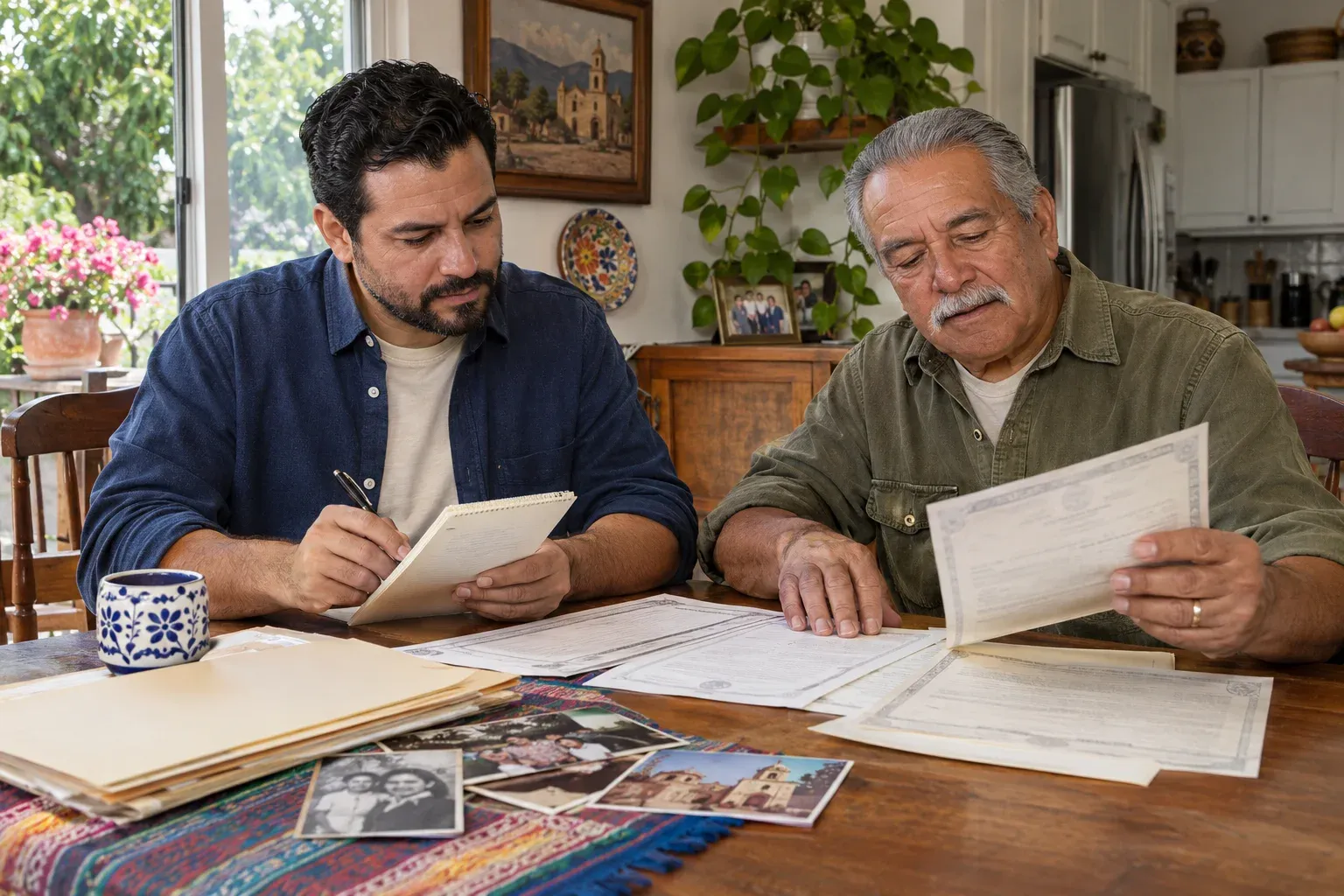
- The long-form U.S. birth certificate (not the abstract) of the person being registered.
- An ID for the person being registered.
- The Mexican birth certificate of the Mexican father or mother (or their Mexican naturalization letter).
- The parents’ valid IDs.
- Depending on the case: a marriage certificate, the father’s notarized power of attorney, a death certificate or a naturalization certificate.
Guides for your case
Every family is different. These pages walk through the most common situations.
Children born in the U.S.
How to register your minor or adult children born in the United States.
Learn moreRequirements
The document checklist, ready to print and bring to your consultation.
Learn moreGrandchildren of Mexicans
What changed with the 2021 reform and in what order to do things.
Learn moreAfter registration
The Mexican birth certificate, CURP and passport, and why they matter.
Learn more
Mexican consulates near our offices
You can apply at the consulate closest to you. These are the consulates nearest our offices, each with a link to its official website.
Los Angeles
Consulate General of Mexico in Los Angeles
San Bernardino
Consulate of Mexico in San Bernardino
Nearby HMN offices
Santa Ana
Consulate of Mexico in Santa Ana
Oxnard
Consulate of Mexico in Oxnard
Nearby HMN offices
San Diego
Consulate General of Mexico in San Diego
Nearby HMN offices
Fresno
Consulate of Mexico in Fresno
Nearby HMN offices
Calexico
Consulate of Mexico in Calexico
Sacramento
Consulate General of Mexico in Sacramento
Each consulate sets its own requirements and appointment method, and they can change. Always check the official page of the consulate you will visit. Hermandad Mexicana Nacional is not part of the Mexican government or its consulates.
Frequently asked questions
How long does it take?
It depends mostly on appointment availability at your consulate. At consulates such as Los Angeles it takes two visits: first they review your documents and, if they’re complete, they give you a date for the registration; the Mexican birth certificate is issued that day. Having your documents in order from the start avoids repeat appointments. We can’t promise dates: appointments are given by the consulate.
Will my child lose U.S. citizenship?
No. The United States allows dual nationality: also being Mexican does not take away U.S. citizenship. See what the U.S. Department of State says about dual nationality.
What if the parents weren’t married?
Yes, it’s possible. When the parents weren’t married or married after the birth, the Los Angeles consulate asks the father to attend the registration appointment, or to give his consent through a notarized special power of attorney, even if the child is now an adult. That way his name can appear on the Mexican birth certificate. We help you decide which option fits.
What if a parent has passed away?
Usually you bring the original death certificate along with the other documents. Some cases are more delicate, for example when the father has died and the parents weren’t married: some consulates can’t do the registration and it has to be done in Mexico. We go over it with you before requesting the appointment.
Do I need an apostille or a translation?
It depends on where you apply and where the birth certificate is from. To register someone born in the United States at a Mexican consulate, the consulates we reviewed ask for the original long-form U.S. birth certificate, with no mention of an apostille. Birth certificates from other countries do need verification or an apostille, and a Spanish translation if they’re not in English or Spanish. If you decide to register your child directly in Mexico, each state civil registry sets its own requirements: ask there before you travel.
Can my grandchildren get it?
Yes, in many cases. Since May 2021, a person born abroad is Mexican by birth even if their Mexican parent was also born outside Mexico. Usually the parent is registered first, then the grandchild. Read the guide for grandchildren.
Can I do it as an adult?
Yes. An adult can register on their own. Besides the usual documents, the Los Angeles consulate asks for the parents’ marriage certificate (from at least six months before the birth) and a U.S. passport. If the parents weren’t married, the father has to give his consent in person or through a notarized power of attorney.
How do I get the Mexican passport afterwards?
With the Mexican birth certificate, you request a passport appointment at the consulate. For a minor, both parents give their authorization on form OP7, and in Los Angeles the minor’s CURP and the authorizing parent’s CURP are also required. See the steps after registration.
How much does it cost?
Consulates set their own fees. For example, the Calexico consulate publishes that birth inscription is free and that extra certified copies cost $20. Our help has an affordable fee, as a nonprofit; we explain it before we start.
Do I have to travel to Mexico?
No. Most people register at a Mexican consulate in the United States, without traveling. It can also be done in Mexico, at the civil registry, under each state’s requirements.
Important notice
This page is general information, not legal advice. Requirements vary from one consulate to another and can change over time; at your consultation we confirm the requirements for your case and your consulate. Hermandad Mexicana Nacional is a nonprofit: it is not part of, or affiliated with, the Mexican government or its consulates.
Book your consultation
We review your documents before your consulate appointment, tell you what’s missing and explain every step, in Spanish or English.
Hermandad Mexicana Nacional is a 501(c)(3) nonprofit. Any fees for our services help keep them low-cost and fund our community programs. We explain every cost before you start.
Get help at any of our 22 offices
Walk in or call the office nearest you. Every office offers service in Spanish and English.
Other services
Citizenship (Naturalization)
We prepare your complete N-400 citizenship application and get you ready for the interview and the civics and English test.
Learn moreDACA
We help you renew Deferred Action (DACA) and your work permit on time, and keep you informed about the program’s current status.
Learn moreGreen Card Renewal
We renew or replace your 10-year permanent resident card if it is expiring, expired, lost, stolen or has incorrect information.
Learn more